Products for Research Use Only

Anti-BBS8/TTC8 Antibody Picoband®
CAT: 0519-A07486-2Size: 100 µg/VialDry Ice: NoHazardous: No
Product image 1
1 / 1
CAT#:0519-A07486-2Size:100 µg/Vial
Selected
24/48H Stock Items & 2 to 6 Weeks non Stock Items.
Quick Request Actions
Background
Tetratricopeptide repeat domain 8 (TTC8) also known as Bardet–Biedl syndrome 8 is a protein that in humans is encoded by the TTC8 gene.This gene encodes a protein that has been ly linked to Bardet-Biedl syndrome. The primary features of this syndrome include retinal dystrophy, obesity, polydactyly, renal abnormalities and learning disabilities. Experimentation in non-human eukaryotes suggests that this gene is expressed in ciliated cells and that it is involved in the formation of cilia. A mutation in this gene has also been implicated in nonsyndromic retinitis pigmentosa. Alternative splicing results in multiple transcript variants.
Description
Boster Bio Anti-BBS8/TTC8 Antibody Picoband® catalog # A07486-2. Tested in ELISA, Flow Cytometry, WB applications. This antibody reacts with Human, Mouse, Rat. The brand Picoband indicates this is a premium antibody that guarantees superior quality, high affinity, and strong signals with minimal background in Western blot applications. Only our best-performing antibodies are designated as Picoband, ensuring unmatched performance.
Synonyms
Inorganic pyrophosphatase; Pyrophosphate phospho-hydrolase; Ppase; PPA1; IOPPP; PP
Gene Name
TTC8
Gene ID
123016
UniProt
Q8TAM2
Host
Rabbit
Reactivity
Human, Mouse, Rat
Cross Reactivity
No cross-reactivity with other proteins.
Immunogen
E.coli-derived human BBS8/TTC8 recombinant protein (Position: E271-Q533) .
Clonality
Polyclonal
Tissue Specificity
Expressed ubiquitously.
Applications
WB, Flow Cytometry, ELISA
Field of Research
Cancer, Cofactors, Vitamins/Minerals, Metabolism, Pathways and Processes, Signal Transduction, Vitamins/Minerals
Purification
Immunogen affinity purified.
Concentration
Adding 0.2 ml of distilled water will yield a concentration of 500 μg/ml.
Form
Lyophilized
Reconstitution
Adding 0.2 ml of distilled water will yield a concentration of 500 μg/ml.
Function
Inhibits both auto-ubiquitination of PARK2 and ubiquitination of target proteins by PARK2 (By similarity) . May function as a nucleotide exchange factor for HSP/HSP70, promoting ADP release, and activating Hsp70-mediated refolding. .
References & Citations
1. Ansley, S. J., Badano, J. L., Blacque, O. E., Hill, J., Hoskins, B. E., Leitch, C. C., Kim, J. C., Ross, A. J., Eichers, E. R., Teslovich, T. M., Mah, A. K., Johnsen, R. C., Cavender, J. C., Lewis, R. A., Leroux, M. R., Beales, P. L., Katsanis, N. Basal body dysfunction is a likely cause of pleiotropic Bardet-Biedl syndrome. Nature 425: 628-633, 2003. 2. Goyal, S., Jager, M., Robinson, P. N., Vanita, V. Confirmation of TTC8 as a disease gene for nonsyndromic autosomal recessive retinitis pigmentosa (RP51) . Clin. Genet. 89: 454-460, 2016. 3. Jin, H., White, S. R., Shida, T., Schulz, S., Aguiar, M., Gygi, S. P., Bazan, J. F., Nachury, M. V. The conserved Bardet-Biedl syndrome proteins assemble a coat that traffics membrane proteins to cilia. Cell 141: 1208-1219, 2010.
Storage Conditions
At -20°C for one year from date of receipt. After reconstitution, at 4°C for one month. It can also be aliquotted and stored frozen at -20°C for six months. Avoid repeated freezing and thawing.
Calculated Molecular Weight
51200 MW
Observed Molecular Weight
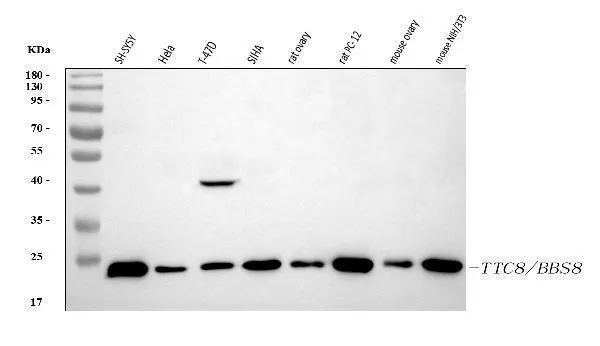
23 kDa
Applications Notes
6
Gene Name Synonym
Pyrophosphatase (inorganic) 1
Subcellular Location
Cytoplasm.
Protein Name
BAG family molecular chaperone regulator 5
Isotype
Rabbit IgG
Contents
Each vial contains 4 mg Trehalose, 0.9 mg NaCl, 0.2 mg Na2HPO4.

UniProtKB · Q8TAM2

Tetratricopeptide repeat protein 8

TTC8_HUMAN · Homo sapiens

View on UniProt ↗
Primary accession
Q8TAM2
Review status
UniProtKB reviewed (Swiss-Prot)
Gene
TTC8
Protein existence
1: Evidence at protein level
Organism
Homo sapiens (Human)
Taxonomy ID
9606
Alternative names
TPR repeat protein 8
EC number
—
Processing
—
Secondary accessions
A6NFG2, B3KWA5, Q67B97, Q86SY0, Q86TV9, Q86U26, Q8NDH9, Q96DG8
Protein keywords

Coding sequence diversity

Alternative splicing

Disease

Bardet-Biedl syndromeCiliopathyDisease variantIntellectual disabilityObesityRetinitis pigmentosa

Cellular component

Cell membraneCell projectionCiliumCytoplasmCytoskeletonMembrane

Biological process

Cilium biogenesis/degradationProtein transportTransport

Technical term

Proteomics identificationReference proteome

Domain

RepeatTPR repeat