

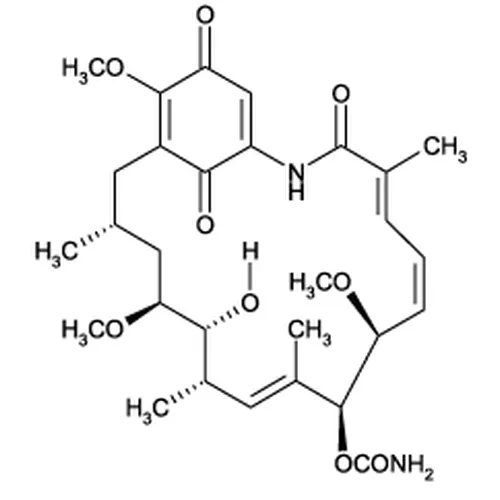
Geldanamycin
Alternative Products
| Catalog | Name |
|---|---|
| A4060-5.1 | Geldanamycin |
Popular Products

Sirius Red/Fast Green Collagen Staining Kit
SKU: 9046|Size: 30-50 Samples
Streptavidin Polystyrene Particles, 0.5% w/v, 5.0-5.9 µm
SKU: SVP-50-5|Size: 5 mL
Sirius Red/Fast Green Dye Solution, 250 ml
SKU: 90463|Size: 250 mL
Rabbit Anti-Rat Connexin 37 (Cx37) IgG # 2, aff pure
SKU: Cx37B12-A|Size: 100 ug
Ni NTA Beads
SKU: SA004500|Size: 500 mL
Mouse Anti-Pneumococcal Type 23F Polysaccharide MAb
SKU: PA2035-01|Size: 100 μL
[IHC]NeuN Rabbit Monoclonal Antibody, 1 pack = 100 µL
SKU: BAL3383|Size: 1 Each
Goat anti-ChAT Polyclonal Antibody
SKU: E48GA023|Size: 100 µL
Rabbit Anti Mouse CHAT Polyclonal Affinity Purified (PBS with 0.02% sodium azide, 1% BSA and 50% glycerol, pH7.4) (IHC) 120UL
SKU: IRBAMLCHATAP28120UL|Size: 120 µL
Rabbit Anti Mouse CHAT Polyclonal Affinity Purified (PBS with 0.02% sodium azide, 1% BSA and 50% glycerol, pH7.4)(IHC)
SKU: MBS8423301-01|Size: 0.12 mL
Ghost-Buster Column, 4.6x50 mm, 40Mpa
SKU: 06100-31000|Size: 4.6x50 mm
Ghost-Buster Column, 7.8x50 mm, 40Mpa
SKU: 06100-31001|Size: 7.8x50 mm
Ghost-Buster Column, 3.0x33 mm , 40Mpa
SKU: 06100-31018|Size: 3.0x33 mm
Ghost-buster Column kit, 4.6x50 mm, with 4 peek fittings, 2 peek tubes, 40Mpa
SKU: GBKIT-01|Size: 4.6x50 mm
Ghost-buster Column kit, 7.8x50 mm, with 4 peek fittings, 2 peek tubes, 40Mpa
SKU: GBKIT-02|Size: 7.8x50 mm
Ghost-buster Column kit, 4.0x50 mm, with 4 peek fittings, 2 peek tubes, 40Mpa
SKU: GBKIT-04|Size: 4.0x50 mm
Ghost-Buster Column II, 4.0x50mm, 40Mpa
SKU: 06100-31008|Size: 4.0x50mm
Ghost-Buster Column II, 3.0x50mm, 40Mpa
SKU: 06100-31016|Size: 3.0x50mm
Ghost-Buster Column II, 4.6x30mm, 40Mpa
SKU: 06100-31026|Size: 4.6x30mm
Ghost-Buster Column II, 4.0x30mm, 40Mpa
SKU: 06100-31027|Size: 4.0x30mm