

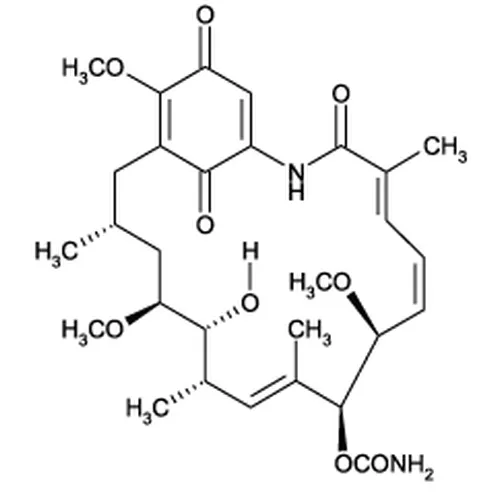
Geldanamycin
Alternative Products
| Catalog | Name |
|---|---|
| A4060-5.1 | Geldanamycin |
Popular Products

Histo-Clear
SKU: HS-200-01|Size: 1 L
Histo-Clear
SKU: NAT1332|Size: 5 US Gallon - 18.9 L
Diogenes
SKU: CL-202|Size: 1 Kit
OptiClear Sample Kit II
SKU: OE-109|Size: 1 L
Glycosaminoglycans Assay Kit
SKU: 6022|Size: 1 Kit
0.2 mL 8-Tube Strip with Caps, Thermo Fisher Style
SKU: PCR8WC-02TN|Size: 0.2 mL
Sirius Red/Fast Green Collagen Staining Kit
SKU: 9046|Size: 30-50 Samples
Streptavidin Polystyrene Particles, 0.5% w/v, 5.0-5.9 µm
SKU: SVP-50-5|Size: 5 mL
Sirius Red/Fast Green Dye Solution, 250 ml
SKU: 90463|Size: 250 mL
Rabbit Anti-Rat Connexin 37 (Cx37) IgG # 2, aff pure
SKU: Cx37B12-A|Size: 100 ug
Human Interferon-inducible protein AIM2 (AIM2) ELISA Kit
SKU: AE19258HU-01|Size: 48 Tests
Mouse Interferon-inducible protein AIM2 (AIM2) ELISA Kit
SKU: AE19259MO-01|Size: 48 Tests
Human interferon-inducible protein 10, IP-10 ELISA Kit
SKU: MBS161044-01|Size: 48 Well
Human Interferon-Inducible Protein 10 (IP-10) ELISA Kit
SKU: MBS3800607-01|Size: 48 Well
Human interferon-inducible protein 10, IP-10 ELISA Kit
SKU: MBS700439-01|Size: 24 Well (LIMIT 1)
Human interferon-inducible protein 10, IP-10 ELISA Kit
SKU: MBS9020997-01|Size: 24 Well (LIMIT 1)
AIM2 (Interferon-inducible protein AIM2, Absent in melanoma 2)
SKU: 305277-01|Size: 50 µL
AIM2 (Interferon-inducible protein AIM2, Absent in melanoma 2)
SKU: 350541|Size: 100 µg
AIM2 (Interferon-Inducible Protein AIM2, Absent in Melanoma 2)
SKU: 474949|Size: 100 µL
AIM2 (Interferon-Inducible Protein AIM2, Absent in Melanoma 2)
SKU: 474950|Size: 100 µL