Products for Research Use Only

Mouse RAGE ELISA Kit PicoKine®
CAT: 0519-EK0828Size: 96 Well With Removable StripsDry Ice: NoHazardous: No
Product image 1
1 / 1
CAT#:0519-EK0828Size:96 Well With Removable Strips
Selected
24/48H Stock Items & 2 to 6 Weeks non Stock Items.
Quick Request Actions
Background
RAGE, the Receptor for Advanced Glycation Endproducts, is a 35kD transmembrane receptor of the immunoglobulin super family. It is also known as “AGER”. AGER gene is mapped to chromosome 6p21.3 by mapping by contiguous cosmids and YAC clones and by fluorescence in situ hybridization. The expression of RAGE is particularly increased in neurons close to deposits of amyloid beta peptide and to neurofibrillary tangles. RAGE has been linked to several chronic diseases, which are thought to result from vascular damage. The pathogenesis is hypothesized to include ligand binding upon which RAGE signals activation of the nuclear factor kappa B (NF-kappaB) .
Description
Mouse RAGE ELISA Kit PicoKine® (96 Tests) . Quantitate Mouse Ager in cell culture supernatants, cell lysates, serum and plasma (heparin, EDTA) . Sensitivity: 10pg/ml. The brand Picokine indicates this is a premium quality ELISA kit. Each Picokine kit delivers precise quantification, high sensitivity, and excellent reproducibility. Only our most reliable and effective kits qualify as Picokine, guaranteeing top-tier results for your assays.
Reproducibility
Lots Lot 1 (pg/ml) Lot 2 (pg/ml) Lot 3 (pg/ml) Lot 4 (pg/ml) Mean (pg/ml) Standard Deviation CV (%) Sample 1 113 119 116 113 115 2.48 2.1% Sample 2 797 796 771 805 792 12.75 1.6% Sample 3 2158 2179 2112 2263 2178 54.73 2.5% Lots Lot 1 (pg/ml) Lot 2 (pg/ml) Lot 3 (pg/ml) Lot 4 (pg/ml) Mean (pg/ml) Standard Deviation CV (%) Lots Lot 1 (pg/ml) Lot 2 (pg/ml) Lot 3 (pg/ml) Lot 4 (pg/ml) Mean (pg/ml) Standard Deviation CV (%) Sample 1 113 119 116 113 115 2.48 2.1% Sample 1 113 119 116 113 115 2.48 2.1% Sample 2 797 796 771 805 792 12.75 1.6% Sample 2 797 796 771 805 792 12.75 1.6% Sample 3 2158 2179 2112 2263 2178 54.73 2.5% Sample 3 2158 2179 2112 2263 2178 54.73 2.5%
Synonyms
Advanced glycosylation end product-specific receptor; Receptor for advanced glycosylation end products; Ager; Rage
Gene Name
AGER
Gene ID
26448
UniProt
Q62151
Reactivity
Mouse
Cross Reactivity
There is no detectable cross-reactivity with other relevant proteins.
Immunogen
Expression system for standard: NS0; Immunogen sequence: Q24-A342
Capture Antibody
Monoclonal antibody from rat
Detection Antibody
Polyclonal antibody from goat
Tissue Specificity
Expressed at higher levels in the coronary arterioles in type 2 diabetic mice (at protein level) . Endothelial cells. .
Applications
ELISA
Field of Research
Alzheimer's Disease, Atherosclerosis, Cardiovascular, Diabetes-associated, Neurodegenerative Disease, Neurology Process, Neuroscience, Sensory System, Vascular Inflammation, Visual System
Standard
10 ng/Tube
Sample Type
Cell culture supernatants, cell lysates, serum and plasma (heparin, EDTA) .
Detection Range
78 pg/mL - 5,000 pg/mL
Precision
Intra-Assay Precision Inter-Assay Precision Sample 1 2 3 1 2 3 n 16 16 16 24 24 24 Mean (pg/ml) 113 797 2158 103 830 2180 Standard deviation 4.63 55.79 90.63 6%5 61.42 130.8 CV (%) 4.1% 7% 4.2% 5% 7.4% 6% Intra-Assay Precision Inter-Assay Precision Sample 1 2 3 1 2 3 n 16 16 16 24 24 24 Mean (pg/ml) 113 797 2158 103 830 2180 Standard deviation 4.63 55.79 90.63 6%5 61.42 130.8 CV (%) 4.1% 7% 4.2% 5% 7.4% 6% Intra-Assay Precision Inter-Assay Precision Intra-Assay Precision Inter-Assay Precision Sample 1 2 3 1 2 3 Sample 1 2 3 1 2 3 n 16 16 16 24 24 24 n 16 16 16 24 24 24 Mean (pg/ml) 113 797 2158 103 830 2180 Mean (pg/ml) 113 797 2158 103 830 2180 Standard deviation 4.63 55.79 90.63 6%5 61.42 130.8 Standard deviation 4.63 55.79 90.63 6%5 61.42 130.8 CV (%) 4.1% 7% 4.2% 5% 7.4% 6% CV (%) 4.1% 7% 4.2% 5% 7.4% 6%
Sensitivity
<10 pg/mL
Function
Mediates interactions of advanced glycosylation end products (AGE) . These are nonenzymatically glycosylated proteins which accumulate in vascular tissue in aging and at an accelerated rate in diabetes. Acts as a mediator of both acute and chronic vascular inflammation in conditions such as atherosclerosis and in particular as a complication of diabetes. AGE/RAGE signaling plays an important role in regulating the production/expression of TNF- alpha, oxidative stress, and endothelial dysfunction in type 2 diabetes. Interaction with S100A12 on endothelium, mononuclear phagocytes, and lymphocytes triggers cellular activation, with generation of key proinflammatory mediators. Interaction with S100B after myocardial infarction may play a role in myocyte apoptosis by activating ERK1/2 and p53/TP53 signaling. Can also bind oligonucleotides. Receptor for amyloid beta peptide. Contributes to the translocation of amyloid-beta peptide (ABPP) across the cell membrane from the extracellular to the intracellular space in cortical neurons. ABPP-initiated RAGE signaling, especially stimulation of p38 mitogen-activated protein kinase (MAPK), has the capacity to drive a transport system delivering ABPP as a complex with RAGE to the intraneuronal space. RAGE-dependent signaling in microglia contributes to neuroinflammation, amyloid accumulation, and impaired learning/memory in a mouse model of Alzheimer disease. .
Components
Description|Quantity Pre-coated 96-well strip microplate|1 Standard|2 vials Biotinylated antibody (100x) |100ul Avidin-Biotin-Peroxidase Complex (100x) |100ul Sample Diluent|30ml Antibody Diluent|12ml Avidin-Biotin-Peroxidase Diluent|12ml Color Developing Reagent (TMB) |10ml Stop Solution|10ml Wash Buffer (25x) |20ml Adhesive plate sealers|4
Storage Conditions
Store at 4°C for 6 months, at -20°C for 12 months. Avoid multiple freeze-thaw cycles (Ships with gel ice, can store for up to 3 days in room temperature. Freeze upon receiving.)
Calculated Molecular Weight
42669 MW
Specificity
Natural and recombinant mouse RAGE
Anticoagulant
Heparin or EDTA
Gene Name Synonym
Advanced glycosylation end product-specific receptor
Subcellular Location
Membrane; Single-pass type I membrane protein.
Sequence Similarities
Contains 2 Ig-like C2-type (immunoglobulin-like) domains.
Protein Name
Advanced glycosylation end product-specific receptor
Sample Data
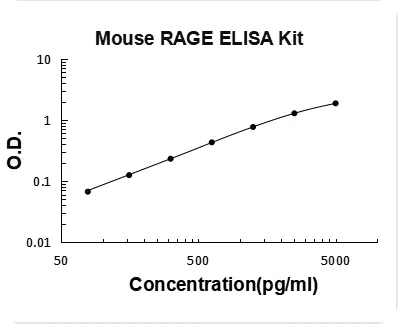
Concentration (pg/ml) 0 78 156 312 625 1250 2500 5000 O.D. 0.022 0.089 0.147 0.254 0.452 0.789 1.306 1.892 Concentration (pg/ml) 0 78 156 312 625 1250 2500 5000 O.D. 0.022 0.089 0.147 0.254 0.452 0.789 1.306 1.892 Concentration (pg/ml) 0 78 156 312 625 1250 2500 5000 Concentration (pg/ml) 0 78 156 312 625 1250 2500 5000 O.D. 0.022 0.089 0.147 0.254 0.452 0.789 1.306 1.892 O.D. 0.022 0.089 0.147 0.254 0.452 0.789 1.306 1.892
Material Required But Not Provided
Microplate Reader capable of reading absorbance at 450nm. Incubator. Automated plate washer (optional) . Pipettes and pipette tips capable of precisely dispensing 0.5 μl through 1 ml volumes of aqueous solutions. Multichannel pipettes are recommended for large amount of samples. Deionized or distilled water. 500ml graduated cylinders. Test tubes for dilution.

UniProtKB · Q62151

Advanced glycation end product-specific receptor

RAGE_MOUSE · Mus musculus

View on UniProt ↗
Primary accession
Q62151
Review status
UniProtKB reviewed (Swiss-Prot)
Gene
Ager
Protein existence
1: Evidence at protein level
Organism
Mus musculus (Mouse)
Taxonomy ID
10090
Alternative names
—
EC number
—
Processing
Precursor
Secondary accessions
C5H3H4, C5H3H5, C5H3H7, C5H3I0, C5H7W3, C5H7W4, C5H7W5, C5H7W6, C5H7W7, C5H7W8, C5H7W9, O35444, Q2PGG1, V5R4Y0
Protein keywords

Technical term

3D-structureReference proteome

Coding sequence diversity

Alternative splicing

Cellular component

Cell membraneCell projectionEndosomeMembraneNucleusSecreted

PTM

Disulfide bondGlycoproteinPhosphoproteinUbl conjugation

Biological process

DNA damageDNA repairDNA replicationInflammatory responsePhagocytosis

Molecular function

DNA-bindingReceptorRNA-binding

Domain

Immunoglobulin domainRepeatSignalTransmembraneTransmembrane helix