
Pyroptosis/Caspase-1 Assay - Green Fluorescent
CAT:
436-9146
Size:
1 Each
Price:
Ask
- Availability: 24/48H Stock Items & 2 to 6 Weeks non Stock Items.
- Dry Ice Shipment: No



Pyroptosis/Caspase-1 Assay - Green Fluorescent
Description:
This Pyroptosis/Caspase-1 Assay Kit utilizes our FLICA® technology to assess pyroptotic cells by detecting caspase-1 activation. Analyze the green fluorescent signal using fluorescence microscopy, a fluorescent plate reader, or by flow cytometry.Specifications:
FAM-YVAD-FMKTarget:
Caspase 1Label:
ICTCell Type:
Jurkat; C2BBe1; THP-1Type:
Cell ViabiityDetection Method:
Flow cytometry, Fluorescence microscope, fluorescence plate readerWavelength:
488 nm / 430 nmAssay Protocol:
1. Prepare samples and controls, 2. Dilute Apoptosis Wash Buffer 1:10 with diH2O., 3. Reconstitute FAM-VAD-FMK with 50 µL DMSO., 4. Dilute FLICA 1:5 by adding 200 µL PBS., 5. Add diluted FLICA to each sample at 1:30 (e.g., add 10 µL of diluted FLICA to 290 µL of sample)., 6. Incubate approximately 1 hour., 7. Remove media, then wash cells: add 1X Apoptosis Wash Buffer and spin cells (twice)., 8. Resuspend samples in 400 µL 1X Apoptosis Wash Buffer, 9. Reconstitute 7-AAD with 260 µL DMSO, 10. Add 7-AAD to each sample at 1:200 (e.g., add 2 µL to 400 µL of sample), 11. Analyze with a fluorescence microscope or flow cytometer. FAM-VAD-FMK excites at 492 nm and emits at 529 nm. 7-AAD excites at 546 nm and emits at 647 nm.Sample Type:
Cell culture; TissueComponents:
Kit 9146: 100-200 tests, FLICA Caspase-1 Inhibitor Reagent (FAM-YVAD-FMK), 4 vials, #655, 10X Cellular Wash Buffer, 60 mL, #6165, Fixative, 6 mL, #636, Hoechst 33342, 1 mL, #639, Nigericin, 0.5 µmoles, #6698, Kit ManualShipping Conditions:
Ships overnight (domestic), International Priority ShippingStorage Temperature:
Nigericin at ≤ -20°C other components at 2-8°CNotes:
Two Pack KitTarget Description:
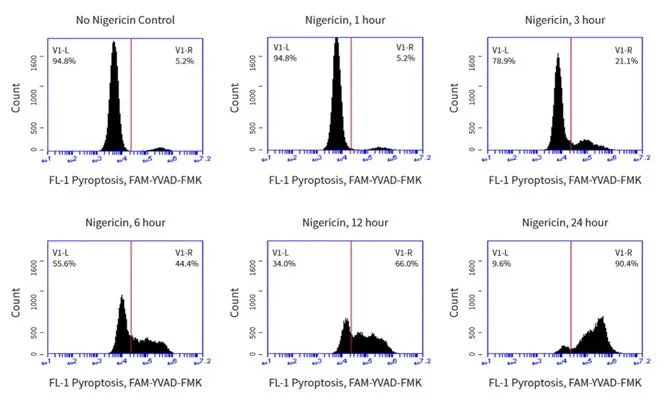
Exposure of inflammatory effector cells like monocytes and macrophages to pathogen-associated molecular patterns (PAMPS), such as viral or bacterial DNA or RNA and bacterial cell wall components like LPS, will typically trigger conformational changes in NACHT leucine-rich repeat protein family (NLRP) proteins. Of the inflammasomes, the NLRP3 inflammasome is the most studied. Activation of the NLRP3 inflammasome follows exposure to PAMPS (first signal) and ATP (second signal)(Figure 1). This leads to oligomerization and assembly of a high molecular weight (~700 kDa) multimeric inflammasome complex, which leads to the conversion of pro-caspase-1 into the catalytically active form. Inflammatory caspases, such as caspase-1, or interleukin- converting enzyme, play a central role in innate immunity by recognizing foreign danger signals and initiating a two-fold response. First, caspase-1, proteolytically converts the proforms of the two important pro-inflammatory cytokines, interleukin 1ß (IL-1ß) and interleukin 18 (IL-18), into their active forms, which are secreted. Second, caspase-1 or caspase-11 triggers a form of lytic, programmed cell death known as pyroptosis. Pyroptosis is a highly inflammatory form of programmed cell death that occurs most frequently upon infection with intracellular pathogens and is likely to form part of the antimicrobial immune response. This pathway is distinct from apoptotic cell death in that it results in plasma-membrane rupture and the release of pro- inflammatory cytokines; infected cells eventually sWell, burst, and die. This, in turn, attracts other immune cells to fight the infection, leading to inflammation of the tissue, and, in a functional response, rapid clearance of bacterial or viral infections. Our Pyroptosis/Caspase-1 Assay Kit utilizes our popular FLICA® technology to detect caspase-1 activation. FLICA probes are cell permeant non-cytotoxic Fluorescent Labeled Inhibitors of CAspases that covalently bind with active caspase enzymes. The kit contains the caspase-1 inhibitor reagent FAM-YVAD-FMK, which has the preferred binding sequence for caspase-1, Tyr-Val-Ala-Asp (YVAD). This preferred caspase-1 binding sequence is labeled with a green fluorescent carboxyfluorescein (FAM) dye and linked to a fluoromethyl ketone (FMK) reactive entity. Caspase-1 will not cleave the FLICA® inhibitor probe; instead, it forms an irreversible covalent bond with the FMK group on the reagent and becomes inhibited from further enzymatic activity. To use FLICA®, add it directly to the cell culture medium, incubate, and wash. FLICA® is cell-permeant and will efficiently diffuse in and out of all cells. If there is an active caspase-1 enzyme inside the cell, it will covalently bind with FAM-YVAD-FMK and retain the green fluorescent signal within the cell. Unbound FLICA® will diffuse out of the cell during the subsequent wash steps. Therefore, positive cells will retain a higher concentration of FLICA® and fluoresce brighter than negative cells. There is no interference from pro-caspases or inactive forms of the enzymes. After labeling with FLICA®, cells can be counter-stained with other reagents and fixed or frozen. Cells labeled with FAM-YVAD-FMK can be counter-stained with reagents such as the red live/dead stains Propidium Iodide (catalog #638) and 7-AAD (catalog #6163). Nuclear morphology may be concurrently observed using Hoechst 33342 (included in the kit), a blue DNA-binding dye. Cells can be viewed through a fluorescence microscope (Figures 2 and 4), or the fluorescence intensity can be quantified using a fluorescence plate reader (Figure 3), or flow cytometer (Figure 5). FAM-FLICA optimally excites at 488-492 nm and has a peak emission at 515-535 nm. Nigericin, a potent microbial toxin derived from Streptomyces hygroscopicus, acts as a potassium ionophore, inducing a net decrease in intracellular levels of potassium which is crucial for oligomerization of the NLRP3 inflammasome and activation of caspase-1. Nigericin requires signaling through pannexin-1 to induce caspase-1 activation and IL-1ß processing and release. Nigericin is included in this kit as a positive control. It has been shown to generate a robust caspase-1 activation response in various cell lines, including Jurkat (Figure 5) and THP-1 cells. FLICA® is for research use only. Not for use in diagnostic procedures. Nigericin induces a net decrease in intracellular levels of potassium, crucial for activation of caspase-1. In pyroptosis experiments, nigericin can be used as a positive control to generate a robust caspase-1 activation response in a variety of cell lines.