
What is qPCR?
Introduction to qPCR
qPCR, also known as quantitative PCR or Q-PCR, is one of the most widely used molecular biology techniques for detecting and quantifying nucleic acids. Researchers use qPCR to measure the amount of DNA or RNA in biological samples with extremely high sensitivity and specificity.
Many scientists ask what is qPCR, what does qPCR measure, and what does qPCR do in laboratory research. In simple terms, qPCR is a refined version of polymerase chain reaction (PCR) that allows scientists to monitor DNA amplification in real time, making it possible to quantify the amount of genetic material present in a sample.
Because of its accuracy and reproducibility, qPCR testing has become a fundamental tool in genetics, microbiology, biotechnology, and molecular diagnostics.

Related Products

qPCR Full Form and Meaning
The qPCR full form is Quantitative Polymerase Chain Reaction.
It is sometimes also referred to as:
- Real-Time PCR
- Quantitative PCR
- Q-PCR
The qPCR meaning refers to the ability of this method to quantitatively measure DNA amplification during each cycle of PCR.
Unlike traditional PCR, which only shows results at the end of amplification, qPCR monitors the reaction as it occurs using fluorescence detection systems.
What Does qPCR Stand For?
When researchers ask what does qPCR stand for, the answer is :
Quantitative Polymerase Chain Reaction
The method measures the accumulation of amplified DNA products during the PCR cycles through fluorescent signals. The intensity of fluorescence correlates with the amount of nucleic acid present in the sample.
This real-time detection allows researchers to determine :
- Gene expression levels.
- Viral or bacterial genetic material.
- Copy number variations.
- Presence of specific genetic sequences.
What is Quantitative PCR?
Quantitative PCR (qPCR) is a molecular biology technique used to amplify and quantify DNA sequences simultaneously. Pubmed
The method combines two fundamental processes :
1-DNA amplification using PCR.
2-Real-time fluorescence monitoring.
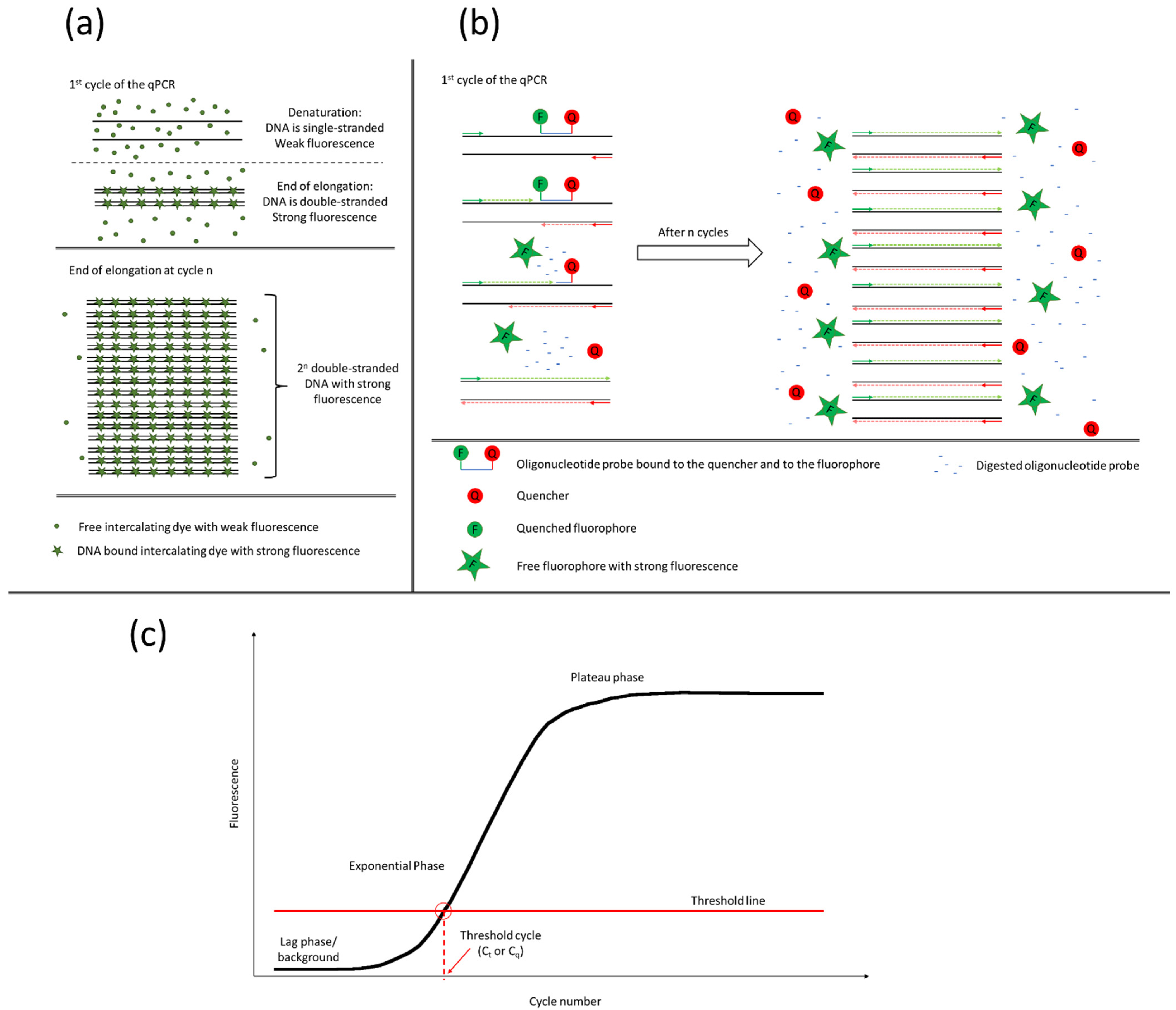
During each amplification cycle, fluorescent dyes or probes generate signals proportional to the amount of amplified DNA. By measuring these signals, scientists can calculate the initial quantity of genetic material present in the sample.

How qPCR Works?
The qPCR process involves repeated cycles of DNA amplification. Each cycle consists of three major steps:
1. Denaturation : DNA strands separate at high temperature.
2. Annealing : Primers bind to specific target sequences.
3. Extension : DNA polymerase synthesizes new DNA strands.In qPCR testing, fluorescence signals are recorded during each cycle. As the DNA template increases, the fluorescence intensity also increases.
This allows the generation of an amplification curve used to calculate the amount of starting DNA.
What Does qPCR Measure?
A common question is what does qPCR measure.
qPCR measures the amount of nucleic acid (DNA or RNA) in a sample by tracking fluorescence generated during amplification.
Specifically, qPCR can measure :
-Gene expression levels.
-Viral genome copies.
-Bacterial DNA presence.
-DNA copy number variations.
-Amplification efficiency.
Because of its quantitative nature, qPCR can detect very small amounts of nucleic acid, making it extremely useful for sensitive research applications.
What Does qPCR Tell You?
qPCR provides precise information about :
- The presence or absence of a genetic sequence
- The quantity of DNA or RNA
- Changes in gene expression
- Relative abundance of nucleic acids
For example, scientists studying gene regulation use qPCR to compare gene expression levels between experimental conditions.
What is the Purpose of qPCR?
The purpose of qPCR is to enable precise quantification of nucleic acids during PCR amplification.
The technology is widely used because it allows scientists to measure DNA or RNA levels accurately and rapidly.
Typical purposes of qPCR include :
- Gene expression analysis.
- Microbial detection.
- Genetic mutation studies.
- Molecular cloning verification.
- Environmental DNA analysis.
What is qPCR Used For?
qPCR applications span many research fields :
-Gene Expression Studies : Researchers use qPCR to quantify mRNA levels and understand gene regulation.
-Pathogen Detection : The technique can detect genetic material from viruses, bacteria, or fungi.
-Molecular Biology Research : Scientists study DNA copy number changes and gene amplification.
-Biotechnology : qPCR is widely used in recombinant DNA experiments and cloning workflows.
-Environmental Monitoring : DNA from environmental samples can be analyzed using qPCR.
qPCR Explained: Why It Is Important in Molecular Biology?
When researchers want qPCR explained, the simplest explanation is that qPCR combines DNA amplification with real-time detection.
This combination allows scientists to :
-Quantify nucleic acids.
-Monitor amplification dynamics.
-Analyze gene expression changes.
-Measure template concentrations.
Because of its accuracy and sensitivity, qPCR has become a gold standard method in molecular biology laboratories worldwide.
Advantages of qPCR
-High Sensitivity : Very small quantities of nucleic acids can be detected.
-Quantitative Analysis : DNA and RNA levels can be measured accurately.
-Rapid Results : Amplification and analysis occur simultaneously.
-Specific Detection : Sequence-specific primers ensure target specificity.
-Reproducibility : qPCR provides consistent and reliable results.
Frequently Asked Questions About qPCR
1/ What is qPCR ?
qPCR is a molecular biology technique used to amplify and quantify DNA sequences in real time using fluorescence detection.
2/ What does qPCR stand for ?
qPCR stands for Quantitative Polymerase Chain Reaction.
3/ What does qPCR measure ?
qPCR measures the amount of DNA or RNA present in a sample during amplification cycles.
4/ What is the purpose of qPCR ?
The purpose of qPCR is to quantify nucleic acids accurately and monitor amplification in real time.
5/ What is qPCR used for ?
qPCR is used for gene expression analysis, microbial detection, genetic research, and molecular biology studies.