

What Is HPLC? High-Performance Liquid Chromatography Explained Scientifically

What Is HPLC? High-Performance Liquid Chromatography Explained Scientifically
Why HPLC Matters in Modern Science?
In laboratories around the world, scientists often face the same challenge: a sample may look like a single liquid, but chemically it can contain dozens, hundreds, or even thousands of compounds. To understand what is inside that sample, researchers need a reliable separation method.
That is where HPLC chromatography becomes essential.
High-performance liquid chromatography is widely used in pharmaceutical analysis, food safety, environmental testing, biotechnology, clinical research, forensic science, and chemical manufacturing. Whether a scientist is testing the purity of a drug, measuring caffeine in a beverage, detecting pesticides in water, or studying proteins in a biological sample, HPLC provides a powerful way to turn chemical complexity into measurable data.
What Does HPLC Stand For?
HPLC stands for High-Performance Liquid Chromatography.
The name describes the technique clearly:
- High-performance means the system provides efficient, precise, and reproducible separation.
- Liquid means the mobile phase is a liquid solvent or solvent mixture.
- Chromatography refers to the process of separating compounds based on how they distribute between a mobile phase and a stationary phase.
Older systems were sometimes called high-pressure liquid chromatography because they used high pressure to move liquid through tightly packed columns. Today, high-performance liquid chromatography is the preferred term because performance, not only pressure, defines the method.
What Is HPLC Chromatography?
- HPLC chromatography is a form of liquid chromatography that separates compounds by forcing a liquid mobile phase through a column packed with a stationary phase. Wikipedia
- Each compound in the sample interacts differently with the column. Some compounds move quickly through the column, while others are delayed because they interact more strongly with the stationary phase. This difference in movement creates separation.
- At the end of the column, a detector records each compound as it exits. The result is a chromatogram, which shows peaks representing separated substances.
- A simple way to understand it :
Sample enters → compounds separate inside the HPLC column → detector measures each compound → chromatogram is produced.
How Does HPLC Work?
HPLC works through controlled chemical separation. The process involves several main steps.
First, the sample is injected into the HPLC system. The sample is usually dissolved in a compatible liquid solvent.
Next, a pump pushes the mobile phase through the system at a controlled flow rate. The mobile phase carries the sample into the HPLC column.
Inside the HPLC column, the sample meets the stationary phase, which is usually made of tiny particles coated with specific chemical groups. Compounds in the sample interact with the stationary phase based on properties such as polarity, charge, molecular size, hydrophobicity, or affinity.
As the mobile phase continues flowing, compounds separate because each one travels through the column at a different speed.
Finally, the separated compounds reach the detector. The detector converts chemical signals into electrical signals, producing peaks on a chromatogram.
The time it takes for a compound to exit the column is called its retention time. Retention time helps scientists identify compounds, while peak area or peak height helps quantify them.

Image Reference : ScienceDirecte
Main Components of an HPLC System
A modern HPLC system contains several highly coordinated parts.
1. Solvent Reservoir :
=> The solvent reservoir holds the mobile phase. The mobile phase may be water, buffer, methanol, acetonitrile, or a mixture of solvents.
2. Pump :
=> The pump moves the mobile phase through the system under high pressure. Stable pressure and flow rate are essential for reproducible results.
3. Injector :
=> The injector introduces a precise volume of sample into the flowing mobile phase.
4. HPLC Column :
=> The HPLC column is the heart of the separation. It contains the stationary phase and determines how effectively compounds are separated.
5. Detector :
=> The detector identifies compounds as they leave the column. Common detectors include UV-Vis, fluorescence, refractive index, electrochemical, and mass spectrometry detectors.
6. Data System :
=> The software records the detector signal and produces the chromatogram. Scientists use the chromatogram to interpret retention time, peak shape, purity, and concentration.
What Is an HPLC Column?
An HPLC column is a narrow tube packed with small particles that create the stationary phase. It is the most important part of the HPLC system because it controls separation selectivity, resolution, retention time, and peak quality.
The column can be imagined as a chemical filter, but it does not simply block molecules by size. Instead, it separates compounds according to their chemical behavior.
Common types of HPLC columns include :
=> C18 columns, widely used in reversed-phase HPLC for nonpolar and moderately polar compounds.
=> C8 columns, similar to C18 but usually less hydrophobic.
=> Silica columns, often used in normal-phase chromatography.
=> Ion-exchange columns, used for charged molecules.
=> Size-exclusion columns, used to separate molecules by size.
=> Chiral columns, used to separate enantiomers.
Choosing the correct HPLC column is one of the most important decisions in method development.
Mobile Phase vs Stationary Phase
To understand how HPLC works, it is necessary to understand the difference between the mobile phase and stationary phase.
- The mobile phase is the liquid that moves through the HPLC system. It carries the sample through the column.
- The stationary phase is the material packed inside the HPLC column. It remains fixed while the mobile phase flows through it.
- Separation occurs because compounds distribute differently between these two phases.
- A compound that prefers the mobile phase will travel faster and exit earlier. A compound that interacts strongly with the stationary phase will move more slowly and exit later.
This balance between movement and interaction is the scientific foundation of HPLC chromatography.

Image Reference : ScienceDirecte
HPLC and Column Chromatography: What Is the Difference?
- HPLC is a highly advanced form of column chromatography.
- Traditional column chromatography often uses gravity to move solvent through a glass column. It can be useful but is slower and less precise.
- HPLC uses high-pressure pumps, small particle columns, precise injectors, sensitive detectors, and computerized data systems. This allows much faster, more accurate, and more reproducible separations.
In short:
Column chromatography is the broad technique. HPLC is the high-performance, instrument-based version of liquid column chromatography.
Types of HPLC
There are several types of HPLC, each designed for different scientific applications.
Reversed-Phase HPLC :
=> Reversed-phase HPLC is the most commonly used type. It uses a nonpolar stationary phase and a polar mobile phase. It is widely used for pharmaceuticals, food compounds, environmental chemicals, and biological molecules.

Image Reference : ScienceDirecte
Normal-Phase HPLC :
=> Normal-phase HPLC uses a polar stationary phase and a less polar mobile phase. It is useful for separating compounds with strong polarity differences.

Image Reference : ScienceDirecte
Ion-Exchange HPLC :
=> Ion-exchange HPLC separates molecules based on electrical charge. It is commonly used for proteins, peptides, amino acids, and inorganic ions.
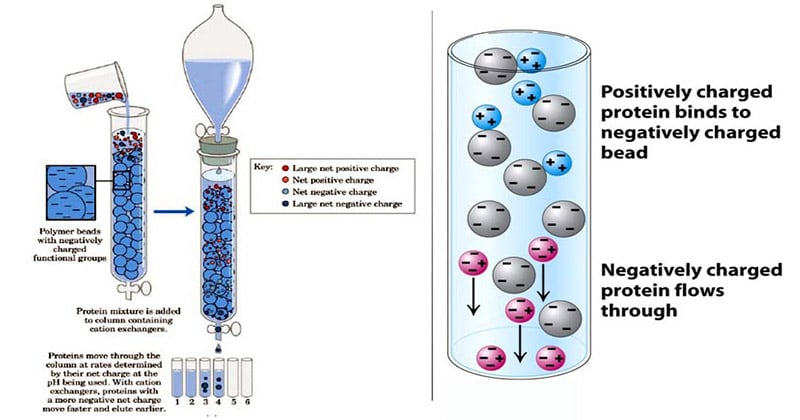
Image Reference : Microbe Notes
Size-Exclusion HPLC :
=> Size-exclusion HPLC separates molecules according to size. Larger molecules exit the column first because they cannot enter the pores of the stationary phase as easily as smaller molecules.

Image Reference : ScienceDirecte
Affinity HPLC :
=> Affinity HPLC separates molecules based on specific biological or chemical interactions, such as enzyme-substrate or antibody-antigen binding.

Image Reference : Microbes Notes
Waters HPLC and Modern Analytical Systems
The term Waters HPLC often refers to HPLC systems, columns, and software produced by Waters Corporation, one of the well-known manufacturers in analytical chromatography.
Modern HPLC systems from major manufacturers are designed for high precision, automation, low carryover, reproducible injections, and compatibility with advanced detectors such as mass spectrometry.
However, the principles of HPLC remain the same across brands: controlled liquid flow, column-based separation, detector response, and chromatographic data analysis.
Why Is HPLC Important?
- HPLC is important because it gives scientists reliable chemical information.
- In pharmaceuticals, HPLC is used to test drug purity, potency, impurities, degradation products, and stability.
- In food science, HPLC can measure vitamins, preservatives, sweeteners, caffeine, pigments, toxins, and contaminants.
- In environmental science, it helps detect pesticides, pollutants, industrial residues, and organic contaminants in water, soil, and air samples.
- In biotechnology, HPLC is used to analyze proteins, peptides, nucleotides, metabolites, and biomolecules.
- In clinical and forensic laboratories, HPLC supports toxicology, therapeutic drug monitoring, and compound identification.
- The strength of HPLC is that it can provide both qualitative and quantitative results with high sensitivity.
What Does an HPLC Chromatogram Show?
An HPLC chromatogram is a graph showing detector response over time.
Each peak usually represents a separated compound. The x-axis shows time, usually in minutes. The y-axis shows detector response.
Important chromatogram features include :
- Retention time, which helps identify a compound.
- Peak area, which helps measure concentration.
- Peak height, which can also support quantification.
- Peak shape, which indicates column performance and method quality
- Resolution, which shows how well two compounds are separated.
A good HPLC method produces sharp, symmetrical, well-separated peaks.
Advantages of HPLC
HPLC offers high accuracy, strong reproducibility, excellent separation power, and compatibility with many sample types. It can analyze very small sample volumes and detect compounds at low concentrations.
Another major advantage is flexibility. By changing the HPLC column, mobile phase, flow rate, temperature, gradient, or detector, scientists can design methods for many different chemical problems.
Limitations of HPLC
Although HPLC is powerful, it also has limitations.
The instruments can be expensive. Solvents and columns add operating cost. Method development requires scientific expertise. Some samples require careful preparation before injection. Poor solvent choice, contaminated samples, air bubbles, damaged columns, or incorrect pH can produce unreliable results.
For best performance, HPLC requires proper maintenance, validated methods, and skilled interpretation.
Future of HPLC: Smarter, Faster, and AI-Assisted
The future of HPLC is moving toward faster separations, greener solvents, smaller sample volumes, automated method development, and AI-assisted data interpretation.
Artificial intelligence can help scientists predict retention time, optimize gradient conditions, detect abnormal peak shapes, identify method failures, and accelerate troubleshooting.
In advanced laboratories, HPLC is increasingly connected with mass spectrometry, robotics, cloud-based data systems, and automated quality control workflows.
This means the next generation of HPLC will not only separate compounds. It will help scientists make better decisions faster.
Key Takeaway
HPLC, or High-Performance Liquid Chromatography, is one of the most important analytical techniques in modern science. It separates chemical compounds using a liquid mobile phase and a stationary phase inside an HPLC column.
By measuring retention time and detector response, scientists can identify and quantify compounds with high precision. From pharmaceuticals and biotechnology to food safety and environmental testing, HPLC chromatography remains a central tool for understanding the chemical world.
FAQ
What is HPLC?
=> HPLC is High-Performance Liquid Chromatography, an analytical technique used to separate, identify, and measure compounds in a liquid sample.
What does HPLC stand for?
=> HPLC stands for High-Performance Liquid Chromatography.
How does HPLC work?
=> HPLC works by injecting a liquid sample into a flowing mobile phase. The sample passes through an HPLC column containing a stationary phase. Compounds separate because they interact differently with the mobile and stationary phases.
What is HPLC chromatography used for?
=> HPLC chromatography is used in pharmaceutical testing, food analysis, environmental monitoring, biotechnology, forensic science, and clinical research.
What is an HPLC column?
=> An HPLC column is a packed tube that contains the stationary phase. It is responsible for separating compounds based on chemical interactions.
What is the mobile phase in HPLC?
=> The mobile phase is the liquid solvent or solvent mixture that carries the sample through the HPLC column.
What is the stationary phase in HPLC?
=> The stationary phase is the material inside the HPLC column that interacts with compounds and helps separate them.
Is HPLC the same as liquid chromatography?
=> HPLC is a high-performance form of liquid chromatography. It uses high pressure, precise columns, and sensitive detectors for advanced separation.
What is the difference between HPLC and column chromatography?
=> Traditional column chromatography often relies on gravity, while HPLC uses high-pressure pumps, advanced columns, detectors, and software for faster and more accurate analysis.
What is Waters HPLC?
=> Waters HPLC usually refers to HPLC instruments, columns, and software made by Waters Corporation. The basic scientific principles are the same as other HPLC systems.