

Bone Resorption
Meaning, Mechanism, Jaw Bone Loss and Clinical Significance

Bone Resorption
What is bone resorption?
Bone resorption is the biological process through which osteoclasts break down mineralized bone tissue. During this process, minerals such as calcium and phosphate are released from the bone matrix, while collagen and other organic components are degraded.
Bone resorption is a normal and necessary part of bone remodeling, the lifelong process that removes old or damaged bone and replaces it with newly formed tissue. It becomes problematic when resorption occurs faster than bone formation, resulting in a progressive reduction in bone mass or structure.
- Bone resorption definition : Bone resorption is the osteoclast-mediated dissolution of the mineral and organic components of bone.
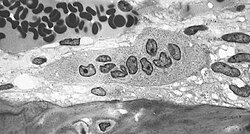
What does bone resorption mean?
The term resorption describes the breakdown and removal of biological tissue. In bone, resorption specifically refers to the controlled removal of bone matrix by specialized cells called osteoclasts.
Bone tissue is not a permanent, inactive material. It continuously adapts to mechanical loading, repairs microscopic damage and participates in mineral regulation. Bone resorption therefore works together with bone formation to preserve skeletal integrity.
In healthy adult bone :
- Osteoclasts remove old or damaged bone.
- The resorbed surface enters a reversal phase.
- Osteoblasts produce new organic bone matrix.
- The new matrix becomes mineralized.
- Bone mass and structural strength are maintained.
This coordinated sequence is known as the bone remodeling cycle.

Image Reference : ScienceDirecte
What cells are responsible for bone resorption?
Bone resorption is primarily performed by osteoclasts. These large, multinucleated cells develop from cells of the monocyte-macrophage lineage.
Osteoclasts attach tightly to a bone surface and create a sealed resorption compartment. Within this compartment, they release hydrogen ions that acidify the local environment and dissolve hydroxyapatite, the principal mineral component of bone. They also release enzymes, particularly cathepsin K, that degrade type I collagen and other components of the organic bone matrix.
- Histology, Osteoclasts => NCBI
- Physiology, Bone => NCBI
Bone-forming cells called osteoblasts subsequently enter the remodeled area and produce new bone matrix. Osteoclast activity and osteoblast activity must remain closely coordinated to prevent either excessive bone accumulation or excessive bone loss.
- The osteoclast, bone remodelling and treatment of metabolic bone disease : Pubmed
- Bone remodeling : Pubmed

Image Reference : ScienceDirecte
How does bone resorption work?
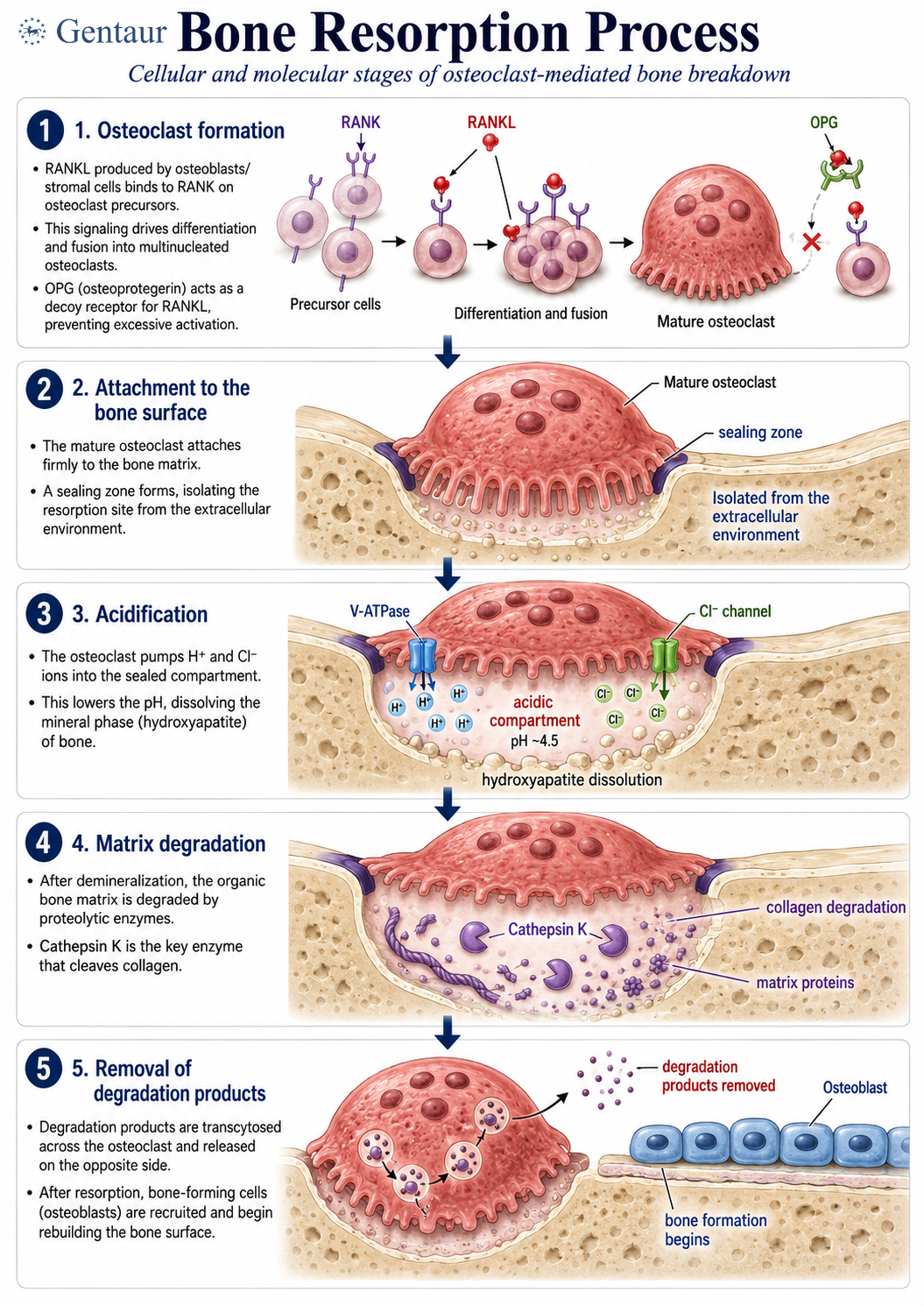
The bone resorption process can be divided into several cellular and molecular stages.
1. Osteoclast formation
- Osteoclast precursor cells express a receptor known as RANK. The binding of RANK ligand, or RANKL, stimulates these precursors to differentiate and fuse into mature osteoclasts.
- Osteoprotegerin, commonly abbreviated as OPG, acts as a decoy receptor. It binds RANKL and prevents it from activating RANK, thereby limiting osteoclast formation and excessive bone resorption.
2. Attachment to the bone surface
- A mature osteoclast attaches to the bone matrix and forms a sealing zone. This isolates the area that will be resorbed from the surrounding extracellular environment.
3. Acidification
- The osteoclast pumps hydrogen and chloride ions into the sealed compartment. The resulting acidic environment dissolves the mineral phase of bone, which is predominantly composed of hydroxyapatite.
4. Matrix degradation
- After demineralization, enzymes such as cathepsin K degrade collagen and other proteins in the bone matrix.
5. Removal of degradation products
- The osteoclast processes and transports the degraded bone material away from the resorption site. Bone-forming cells can then begin rebuilding the surface.
Bone resorption and bone remodeling
Bone remodeling is the coordinated replacement of old bone with new bone. Bone resorption is the removal phase of this cycle, while bone formation is the rebuilding phase.

Bone remodeling helps repair microdamage, maintain bone architecture and regulate calcium and phosphate balance. In a healthy adult skeleton, the quantity of bone removed is generally balanced by the quantity subsequently formed.
Bone remodeling: an operational process ensuring survival and bone mechanical competence : Pubmed
When resorption persistently exceeds formation, net bone loss occurs.

What regulates bone resorption?
Bone resorption is regulated by interactions among bone cells, immune cells, hormones, cytokines and mechanical signals.
The RANK–RANKL–OPG pathway
The RANK–RANKL–OPG system is one of the principal molecular regulators of osteoclast formation.
- RANK is expressed on osteoclast precursors.
- RANKL stimulates osteoclast differentiation, activation and survival.
- OPG binds RANKL and limits its ability to activate RANK.
A higher functional RANKL-to-OPG balance can favor osteoclast formation and bone resorption, while greater OPG activity can suppress osteoclast development.
Osteoclast differentiation by RANKL and OPG signaling pathways : Pubmed
Biology of RANK, RANKL, and osteoprotegerin : Pubmed
Inflammatory mediators
Inflammatory cytokines can enhance osteoclast formation and activity. This mechanism is particularly important in periodontitis and other inflammatory conditions associated with local bone destruction.
Mechanical loading
Bone cells respond to mechanical forces. Appropriate loading supports skeletal adaptation, whereas major changes in loading may alter bone modeling and remodeling. The reduction in functional stimulation after tooth loss is one factor associated with remodeling of the alveolar ridge.
Scientific importance of studying bone resorption
Research into bone resorption is important across several fields:
- Osteoporosis research
- Periodontology
- Dental implantology
- Orthodontics
- Bone metastasis research
- Fracture repair
- Biomaterial testing
- Bone-regeneration studies
- Osteoclast differentiation assays
- Dr ug discovery
- Tissue engineering
Laboratory studies frequently evaluate osteoclast differentiation, RANKL signaling, resorption-pit formation, cathepsin K activity and interactions between osteoclasts, osteoblasts and immune cells.
Understanding these pathways helps researchers distinguish physiological remodeling from pathological bone destruction.
Key scientific references
1- Hadjidakis DJ, Androulakis II. Bone remodeling. Pubmed
2- Kenkre JS, Bassett JHD. The bone remodelling cycle. Pubmed
3- Boyce BF, Xing L. Biology of RANK, RANKL, and osteoprotegerin. Pubmed
4- Udagawa N, et al. Osteoclast differentiation by RANKL and OPG signaling pathways. Pubmed
5- Tan WL, et al. Post-extractional alveolar hard and soft tissue dimensional changes in humans. Pubmed
6- Hienz SA, et al. Mechanisms of bone resorption in periodontitis. Pubmed
7- Omi M, Mishina Y. Roles of osteoclasts in alveolar bone remodeling. Pubmed
This article is intended for scientific and educational information and is not a substitute for individual medical or dental evaluation.