

Bacterial Transformation
Complete Guide to DNA Uptake in Bacteria (E. coli, Plasmids & Protocols).

Bacterial Transformation
🔬 What is Bacterial Transformation?
Bacterial transformation is a fundamental process in molecular biology where bacteria take up external DNA from their environment and incorporate it into their genome or maintain it as a plasmid.
👉 “What is bacterial transformation?”
It is the uptake and expression of foreign DNA by bacterial cells, commonly used in genetic engineering, cloning, and biotechnology.
🧪 Types of Bacterial Transformation
🔹 1. Chemical Transformation (Heat Shock) :
The most widely used method for E. coli transformation.
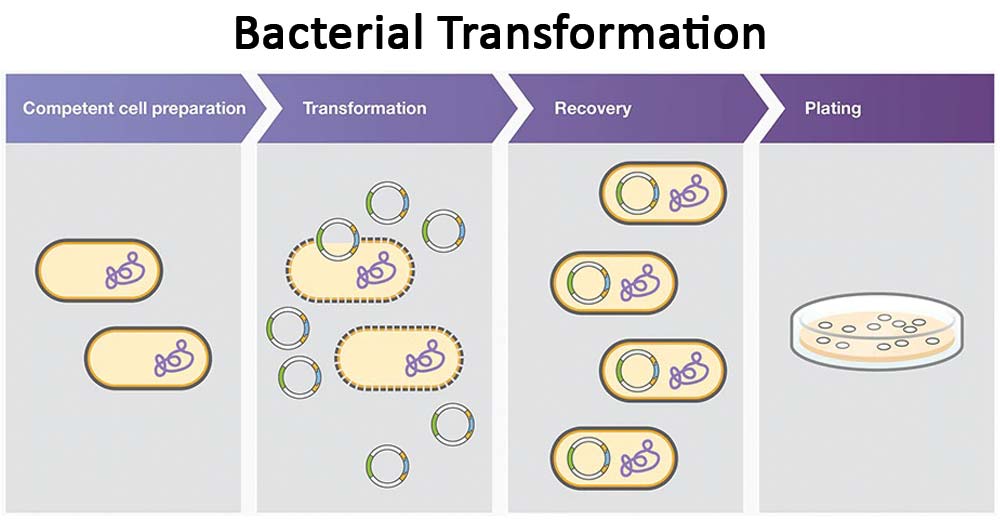
Steps of bacterial transformation (heat shock method) :
1- Prepare competent cells (CaCl₂ treatment).
2- Add plasmid DNA.
3- Incubate on ice.
4- Heat shock at 42°C.
5- Recover in growth medium.
6- Plate on selective agar.
🔹 2. Electroporation Transformation :
A high-efficiency method using electrical pulses.
How does electroporation work?
- Electric pulse creates temporary pores in the membrane.
- DNA enters the bacterial cell.
🧫 Plasmid Transformation & DNA Uptake
Most transformation experiments involve plasmid DNA transformation.
🔹 What is plasmid transformation?
It is the introduction of a recombinant plasmid into bacteria for:
- Gene cloning
- Protein expression
- DNA amplification
⚙️ Bacterial Transformation Process (Step-by-Step)
✔ Complete Transformation Protocol
- Prepare competent cells.
- Add plasmid DNA.
- Incubate (ice phase).
- Heat shock / Electroporation.
- Recovery phase.
- Plate on selective media.
- Incubate and analyze colonies.
🧠 Mechanism of Transformation in Bacteria
Bacteria naturally or artificially become competent, allowing DNA uptake.
🔹 Mechanism :
- DNA binds to cell surface
- Transported across membrane
- Incorporated into genome or plasmid
🧬 Competent Cells Explained
What are competent cells?
Competent cells are bacteria treated to allow DNA uptake.
🔹 Types:
- Chemically competent cells.
- Electrocompetent cells.
⚡ Transformation Efficiency
✔ What is transformation efficiency?
It measures how many bacteria successfully take up DNA.
👉 Expressed as :
- Colonies per µg of DNA.
🔥 Heat Shock: Why 42°C?
“Why are cells incubated at 42°C?”
- Heat shock creates a thermal imbalance
- Helps DNA enter the cell
🧪 Applications of Bacterial Transformation
- Gene cloning.
- Recombinant protein production.
- Genetic engineering.
- Biotechnology research.
📊Bacterial Transformation in E. coli
E. coli transformation is the most common system due to:
- Fast growth.
- Easy handling.
- High efficiency.
To Summarize
Bacterial transformation is a cornerstone of modern molecular biology, enabling scientists to manipulate DNA, clone genes, and produce recombinant proteins.
From heat shock transformation to electroporation, mastering these techniques is essential for success in biotech, research, and diagnostics.
🔍 FAQ
❓ What is bacterial transformation in simple terms?
It is the process where bacteria take up external DNA and express it.
❓ What is the purpose of bacterial transformation?
To introduce new genetic material into bacteria for cloning or protein production.
❓ What is the difference between transformation and transfection?
Transformation is used for bacteria, while transfection is used for eukaryotic cells.
❓ What is plasmid transformation?
It is the insertion of plasmid DNA into bacteria.