

Anti-Myc Tag Antibody Guide
Myc Tag Sequence, 9E10, JAC6, PE & Biotin Formats
Learn how anti-Myc tag antibodies detect Myc-tagged proteins, the Myc tag sequence, 9E10 and JAC6 clones, PE and biotin formats, applications and troubleshooting.

Anti-Myc Tag Antibody Guide
What Is an Anti-Myc Tag Antibody?
An anti-Myc tag antibody is an antibody designed to recognize the short Myc epitope tag commonly fused to recombinant proteins for experimental detection, localization, immunoprecipitation and other protein-analysis applications.
The canonical Myc tag sequence is EQKLISEEDL, a 10-amino-acid peptide derived from the C-terminal region of human c-Myc. Because the tag is small, it can often be introduced at the N- or C-terminus of a recombinant protein without adding a large fusion domain.
Anti-Myc antibodies have consequently become established tools in molecular biology, recombinant protein research, cell biology and protein-interaction studies. The well-known Myc antibody 9E10 recognizes this linear epitope, and biochemical mapping has identified particularly important residues within the Myc sequence for antibody recognition.
Quick Answer
An anti-Myc tag antibody detects proteins carrying the Myc epitope EQKLISEEDL. Depending on the antibody clone and formulation, Myc-tagged proteins may be studied by methods such as Western blotting, immunoprecipitation, immunofluorescence, ELISA or flow cytometry.
The correct antibody should be selected according to the experimental application, antibody clone, host species, conjugation, sample preparation and position of the Myc tag.
What Is the Myc Tag Sequence?
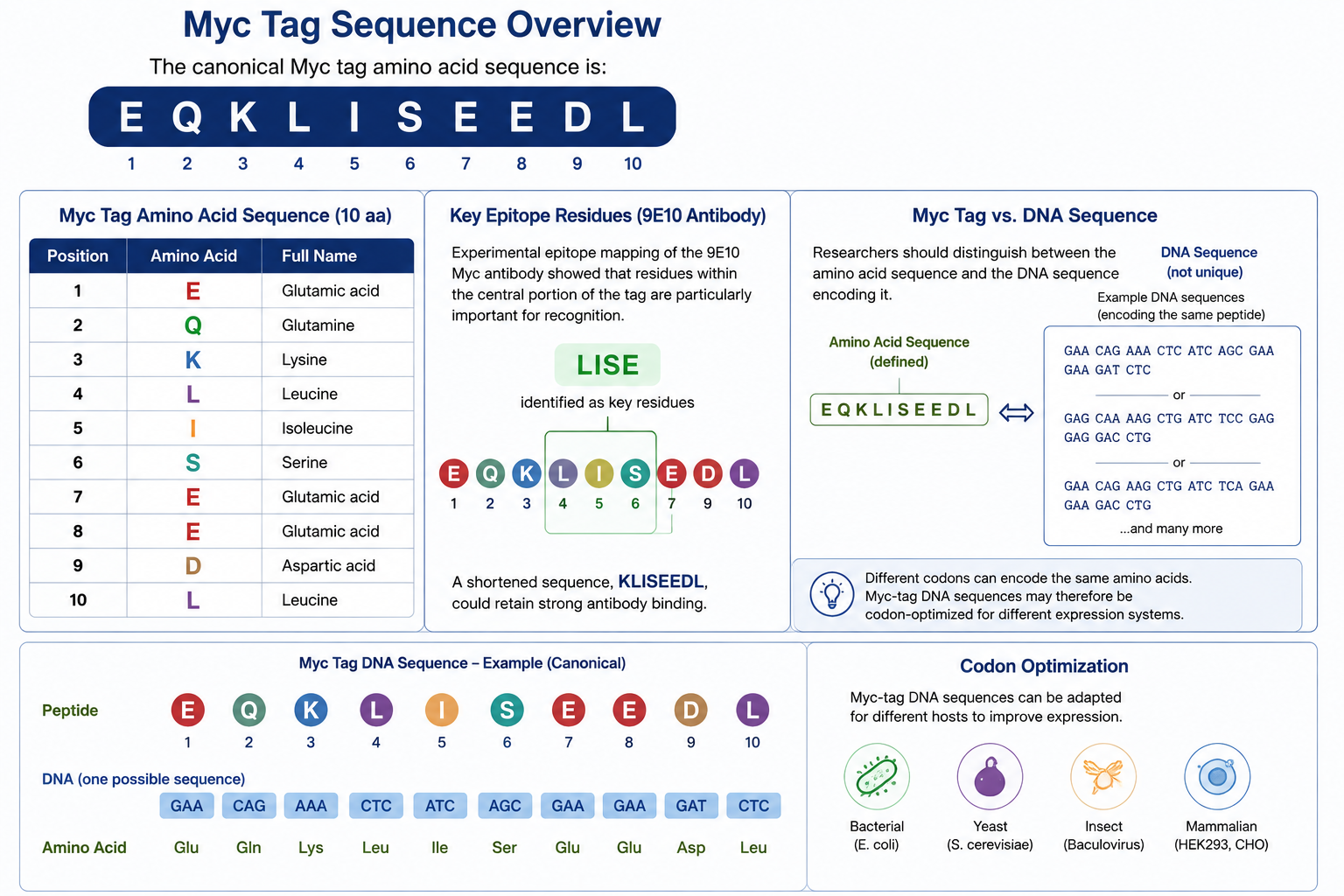
The canonical Myc tag amino acid sequence is : EQKLISEEDL
This sequence contains 10 amino acids :
Position 1 => Amino Acid : E - Glutamic acid
Position 2 => Amino Acid : Q - Glutamine
Position 3 => Amino Acid : K - Lysine
Position 4 => Amino Acid : L - Leucine
Position 5 => Amino Acid : I - Isoleucine
Position 6 => Amino Acid : S - Serine
Position 7 => Amino Acid : E - Glutamic acid
Position 8 => Amino Acid : E - Glutamic acid
Position 9 => Amino Acid : D - Aspartic acid
Position 10 => Amino Acid : L - Leucine
Experimental epitope mapping of the 9E10 Myc antibody showed that residues within the central portion of the tag are particularly important for recognition. The study identified LISE as key residues and found that a shortened sequence, KLISEEDL, could retain strong antibody binding.
Researchers searching for the Myc tag sequence should also distinguish between the amino acid sequence and the DNA sequence encoding it. The peptide sequence is defined, whereas there is no single obligatory nucleotide sequence because different codons can encode the same amino acids. Myc-tag DNA sequences may therefore be codon-optimized for bacterial, yeast, insect or mammalian expression systems.
Myc Tag Antibody vs Myc Antibody: What Is the Difference?
The terms Myc tag antibody and Myc antibody are sometimes used interchangeably in laboratory searches, but scientifically they should be interpreted carefully.
A Myc tag antibody is generally selected to detect the engineered Myc epitope incorporated into a recombinant fusion protein. By contrast, an antibody described simply as a c-Myc antibody may be intended to detect endogenous MYC protein.
The distinction is important because the Myc epitope itself originated from human c-Myc. The original monoclonal antibodies that ultimately enabled widespread use of the Myc epitope were generated against synthetic peptides derived from human c-Myc.
Therefore, researchers should not assume that every antibody returned for the search term “myc antibody” has identical specificity or experimental behavior.
Before use, verify :
- antibody specificity
- clone
- validated application
- host species and isotype
- conjugation
- whether the reagent is intended primarily for a recombinant Myc tag, endogenous c-Myc, or both.
How Does an Anti-Myc Tag Antibody Work?
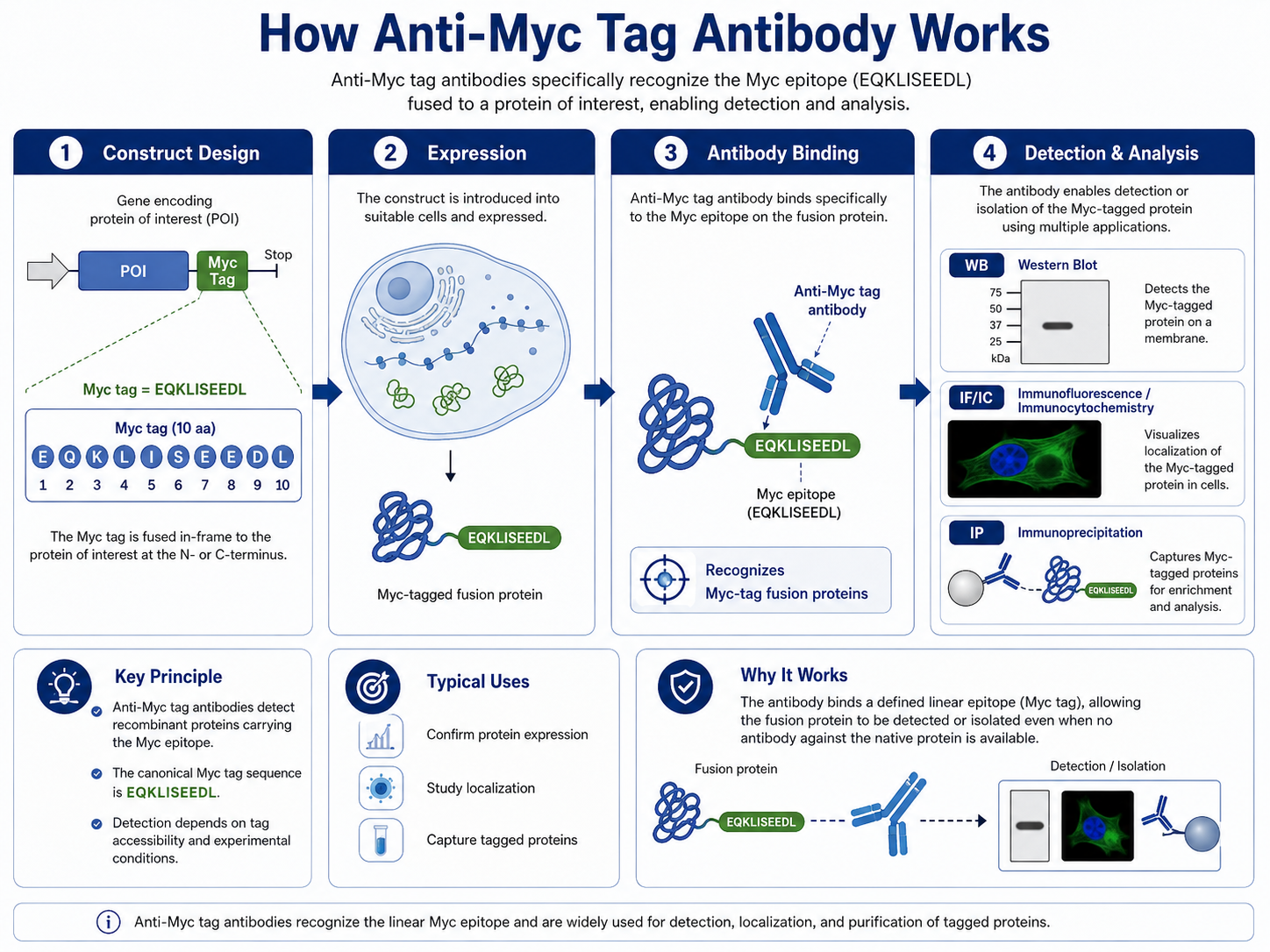
A recombinant gene can be engineered so that the coding sequence for the Myc epitope is fused to the protein of interest. Expression of the construct produces a protein containing the Myc tag.
An anti-Myc tag antibody binds the exposed epitope and allows the fusion protein to be detected or isolated.
For example, in a Western blot experiment, proteins are separated by electrophoresis and transferred to a membrane. An anti-Myc antibody recognizes the Myc-tagged protein, and the antibody signal identifies the recombinant protein at its expected molecular weight.
In immunoprecipitation, the same antibody concept can be used to capture the Myc-tagged protein from a complex lysate. Associated proteins may subsequently be examined when the experimental design is intended to investigate protein interactions.
The tag can therefore function as a standardized detection handle even when a highly validated antibody against the native protein is unavailable.

What Is the Myc Antibody 9E10?
9E10 is one of the best-known monoclonal antibodies associated with the Myc epitope tag. The Myc epitope emerged from early work in which monoclonal antibodies were generated against peptides derived from human c-Myc.
The commonly recognized 9E10 epitope is : EQKLISEEDL
Because of its historical use and broad adoption, searches such as “myc antibody 9E10,” “anti myc tag antibody 9E10,” and “9E10 Myc antibody” remain common when researchers select reagents for tagged-protein experiments.
However, clone identity should not be considered a minor technical detail.
A systematic study comparing several Myc-tag antibodies found that recognition can depend on the sequence surrounding the tag and on whether the epitope is positioned at the N- or C-terminus of the fusion protein. In that study, 9E10 displayed particularly strong context-dependent variability compared with some alternative Myc-tag antibodies.
This observation has an important practical consequence: failure to detect a Myc-tagged protein does not automatically demonstrate that the recombinant protein is absent.
Does the Position of the Myc Tag Matter?
Yes. The position and molecular environment of the Myc tag can affect antibody accessibility.
A Myc tag may be engineered at the N-terminus, C-terminus or, in selected constructs, an internal permissive site. The optimal location depends on the protein and experimental objective.
Tag accessibility may be influenced by protein folding, neighboring amino acids, interactions with other proteins, membrane topology and sample processing.
The sequence context is especially important when interpreting experiments performed with clone 9E10. Comparative research demonstrated that Myc-tag recognition can change significantly according to neighboring sequences.
When designing a new construct, researchers should therefore consider both biological function and antibody accessibility rather than selecting tag position solely for cloning convenience.
Anti-Myc Tag Antibody [JAC6]: What Does the Clone Name Mean?
JAC6 is another monoclonal antibody clone associated with recognition of the Myc epitope.
Searches for “anti-myc tag antibody [JAC6]” usually reflect researchers looking for a specific antibody clone rather than for the general antibody category.
Clone information matters because two antibodies recognizing the same or overlapping Myc epitope can differ in affinity, host species, isotype, formulation and performance under different experimental conditions.
Consequently, a JAC6 anti-Myc tag antibody and a 9E10 anti-Myc tag antibody should not automatically be treated as experimentally interchangeable.
When changing clones, researchers should re-optimize antibody concentration and confirm performance with appropriate positive and negative controls.
Related Products
PE Anti-Myc Tag Antibody [9E10]: When Is PE Conjugation Useful?
A PE anti-Myc tag antibody [9E10] refers to an antibody recognizing the Myc epitope that has been conjugated to phycoerythrin (PE).
PE is a fluorescent reporter commonly used in flow cytometry and fluorescence-based detection. Direct conjugation means that the fluorophore is physically attached to the primary antibody, potentially eliminating the need for a fluorescent secondary antibody.
This can simplify staining workflows and is particularly useful when several markers must be measured simultaneously.
However, researchers should verify that the specific PE-conjugated antibody has been validated for the intended experiment. Excitation and emission compatibility, compensation requirements, tag accessibility, controls and instrument configuration must all be considered when designing multicolor flow cytometry experiments.
The search term “PE anti-myc tag antibody [9E10]” therefore describes a specific detection format rather than a fundamentally different Myc epitope.

Immunofluorescence using natural or multi-species anti-Myc 9E10 antibodies. l ResearchGate
Biotin Anti-Myc Tag Antibody [9E10]: How Is It Used?
A biotin anti-Myc tag antibody [9E10] is a Myc-binding antibody conjugated to biotin.
Biotinylated antibodies can be detected through the high-affinity interaction between biotin and streptavidin. Streptavidin can itself be linked to fluorophores, enzymes or other reporter molecules.
This format can be useful for techniques in which indirect detection or signal amplification is desirable.
Potential applications include immunoassays, protein-detection workflows and selected fluorescence-based experiments, provided that the specific reagent has been validated for the intended method.
As with PE-conjugated antibodies, the presence of a biotin label does not change the Myc tag sequence being recognized. Instead, it changes the downstream detection strategy.
Which Applications Use a Myc Tag Antibody?
Western Blotting
=> Western blotting is one of the most common methods for detecting Myc-tagged recombinant proteins.
=> An anti-Myc tag antibody can help determine whether the tagged construct is expressed and whether the detected band corresponds approximately to the predicted molecular weight of the fusion protein.
=> Controls remain essential because additional bands may result from nonspecific antibody binding, degradation products, incomplete processing or expression of unexpected protein species.
Immunoprecipitation
=> A Myc tag antibody can be used to isolate Myc-tagged proteins from cell or tissue lysates.
=> Immunoprecipitation can support studies of protein expression, purification and protein-protein interactions. The tag must remain sufficiently accessible under the selected lysis and binding conditions.
Immunofluorescence and Immunocytochemistry
=> Anti-Myc antibodies may be used to investigate the cellular localization of Myc-tagged proteins.
=> Fixation and permeabilization conditions can strongly influence epitope availability, so conditions should be optimized for the tagged protein and antibody used.
Flow Cytometry
=> Flow cytometry may use fluorescently labeled antibodies, including formats such as PE anti-Myc tag antibody, when the experimental configuration makes the tag accessible to antibody staining.
=> For intracellular Myc-tagged proteins, fixation and permeabilization are typically required.
ELISA and Related Immunoassays
=> The Myc epitope can also function as a standardized detection element in immunoassay development. Myc-tag recognition has been studied experimentally in ELISA as well as other immunochemical methods.
How to Choose the Best Anti-Myc Tag Antibody
The best anti-Myc tag antibody is the antibody that has been validated for the intended application and performs reliably with the particular fusion-protein construct being studied.
Selection should not be based only on the term “anti-Myc.”
Researchers should evaluate the antibody clone, antibody host, isotype, conjugation, purification, formulation, validated applications and experimental controls. Tag position and surrounding protein sequence should also be considered because epitope accessibility can affect detection.
An unconjugated primary antibody may be appropriate for conventional Western blotting with a secondary antibody, whereas directly labeled antibodies can be advantageous in fluorescence experiments.
Similarly, a biotin anti-Myc tag antibody may be preferred where streptavidin-based detection is part of the assay design, while a PE anti-Myc tag antibody may be appropriate for compatible flow cytometry applications.
Anti-Myc Tag Antibody Troubleshooting Guide
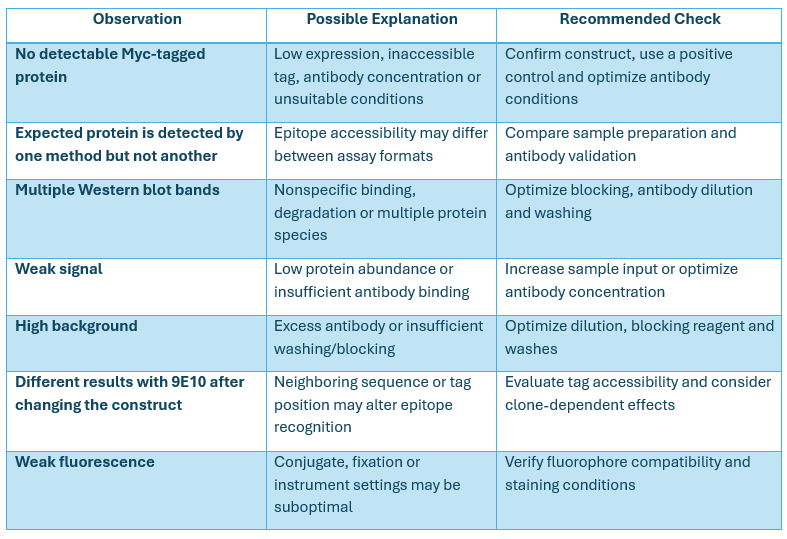
The observation that Myc-tag detection can depend on neighboring sequence context is particularly relevant when troubleshooting clone 9E10.
Related Products
Frequently Asked Questions About Anti-Myc Tag Antibodies
What does an anti-Myc tag antibody recognize?
- An anti-Myc tag antibody generally recognizes the Myc epitope EQKLISEEDL incorporated into a recombinant protein. Epitope recognition can vary between antibody clones and experimental conditions.
What is the Myc tag sequence?
- The canonical Myc tag sequence is EQKLISEEDL, a peptide of 10 amino acids derived from human c-Myc.
What is Myc antibody 9E10?
- 9E10 is a historically important monoclonal antibody used for recognition of the Myc epitope tag. Its recognition of tagged proteins can be affected by neighboring sequence context and tag position.
Is a Myc antibody the same as an anti-Myc tag antibody?
- Not necessarily. “Myc antibody” can refer to antibodies detecting endogenous c-Myc, while “anti-Myc tag antibody” normally refers to detection of an engineered Myc epitope. Researchers should check the antibody's stated specificity.
What is an anti-Myc tag antibody [JAC6]?
- JAC6 identifies a specific monoclonal antibody clone associated with Myc-epitope recognition. Clone identity should be considered when comparing antibodies because different clones can have different experimental characteristics.
What is PE anti-Myc tag antibody [9E10]?
- It is a PE-conjugated anti-Myc antibody, typically intended for fluorescence-based detection such as compatible flow cytometry workflows. The precise validated applications should always be confirmed for the individual reagent.
What is biotin anti-Myc tag antibody [9E10]?
- It is a biotin-conjugated Myc-binding antibody that can be detected through streptavidin-based reporter systems.
Can an anti-Myc tag antibody be used for Western blotting?
- Yes, Myc-tag antibodies are widely used for Western blot detection of recombinant Myc-tagged proteins. However, validation is clone- and product-specific, and tag context can influence detection.
Can the Myc tag be placed at either protein terminus?
- The Myc tag can often be engineered at either the N- or C-terminus, but the optimal position depends on protein structure and function. Tag position can also influence recognition by the antibody.
Why can a Myc-tagged protein give a weak signal with 9E10?
- Weak detection may result from low protein abundance, experimental conditions or poor accessibility of the epitope. Research has specifically demonstrated that 9E10 recognition can vary substantially depending on neighboring amino acid sequences.
Anti-Myc Tag Antibody for Recombinant Protein Research
The anti-Myc tag antibody remains a useful tool for studying recombinant proteins because it allows a standardized short epitope to be detected across many different fusion constructs.
The Myc tag's small size and well-characterized sequence make it suitable for a broad range of molecular and cellular biology workflows. Nevertheless, successful detection depends on more than simply adding the EQKLISEEDL Myc tag sequence to a protein.
Researchers should consider tag position, sequence context, antibody clone, conjugation, sample preparation and application-specific validation when designing experiments.
For researchers evaluating an Anti-Myc Tag Antibody from Gentaur, the product datasheet should be consulted for the exact clone, host species, isotype, formulation, concentration, validated applications and recommended storage conditions before establishing an experimental protocol.
Gentaur Anti-Myc Tag Antibody product page.

Related Products
Scientific References
- Evan GI, Lewis GK, Ramsay G, Bishop JM. Isolation of monoclonal antibodies specific for human c-myc proto-oncogene product. Molecular and Cellular Biology. Pubmed
- Hilpert K, Hansen G, Wessner H, et al. Anti-c-myc antibody 9E10: epitope key positions and variability characterized using peptide spot synthesis on cellulose. Pubmed
- Schüchner S, Behm C, Mudrak I, Ogris E. The Myc tag monoclonal antibody 9E10 displays highly variable epitope recognition dependent on neighboring - sequence context. Pubmed